
Welcome to the first entry in a new series, called RPG studies. In this series, I will go through some roleplaying games that I think are useful and inspiring for game designers to analyze.
I will mostly be talking about more niche RPGs, both because people are less likely to know about them and because they often take interesting risks. The featured games will also sometimes stretch the definition of an RPG, all the better to get influence from the periphery or even outside of genre boundaries.
So I will mostly be ignoring games by Bethesda, Bioware, Larian, CD Projekt Red, et al. Those are assumed to be common knowledge.
All right, without further ado, let’s get into our first game.
Streets of Rogue
 Streets of Rogue title screen1
Streets of Rogue is often described as “Deus Ex meets GTA” and as the name suggests, is a (non-traditional) roguelike2. The game has you go through six stages of a city on your quest to liberate it from the clutches of a corrupt mayor.
If you are not already familiar with it, the trailer provides a good overview of the game:
Lessons
Here I’ll list features and aspects of the game that I think are useful for a game designer to study.
Character integration
In Streets of Rogue, both you and the Non-Player Characters (NPCs) use the same pool of character classes. This is a classic roguelike pattern now used in other genres as well.
Because a roguelike is typically a very simulation-heavy genre, it pays dividends to have the “monsters” and the player share the same code. This is something Nethack famously did NOT do and are still paying the price for.
In Streets of Rogue the practical consequence of this is that the player can play as (almost) any NPC role in the game. Want to be a zombie? Sure. A bartender? Yes.
There are some differences. For example, a player playing as a shopkeeper does not literally run a shop in the game like the NPCs do. But mostly the same systems are used by the player and NPCs.
This includes things like allegiances, where members of the same gang defend each other when attacked, both NPC and player thieves pickpocket passersby and vampires heal by sucking the blood out of their victims.
Which leads us to our next point.
Character variety
Compared to your standard RPG, Streets of Rogue has an incredible list of character options that actually play differently.
For example, play as a cop and:
- Other cops will defend you if you are attacked
- You can handcuff any NPC, incapacitating them
- You lose experience if you arrest or kill innocent people3
- You can enter and exit police stations at will
On the other hand, playing as a gorilla, you can’t talk to people or use guns at all and scientists attack you on sight. A bartender can turn any chemical into a servable drink. Et cetera, et cetera.
Note that roles like the bartender would not be possible if most of the NPCs were not neutral or if there was a strict separation between non-combat NPCs (townies) and combat NPCs (monsters). A lot of the local variety is driven by which NPCs you have befriended and offended on the current level.
Another big part of why this variety is possible is that like most traditional roguelikes and unlike most RPGs, there are is no separate tactical combat minigame that every character must take part in.
No combat or dialogue minigames
Everything in Streets of Rogue happens in the same game mode, not including out-of-gameplay activities like level up screens.
Talking, fighting and sneaking around all take place in the same mode and can therefore be transitioned into and out of fast and smooth.
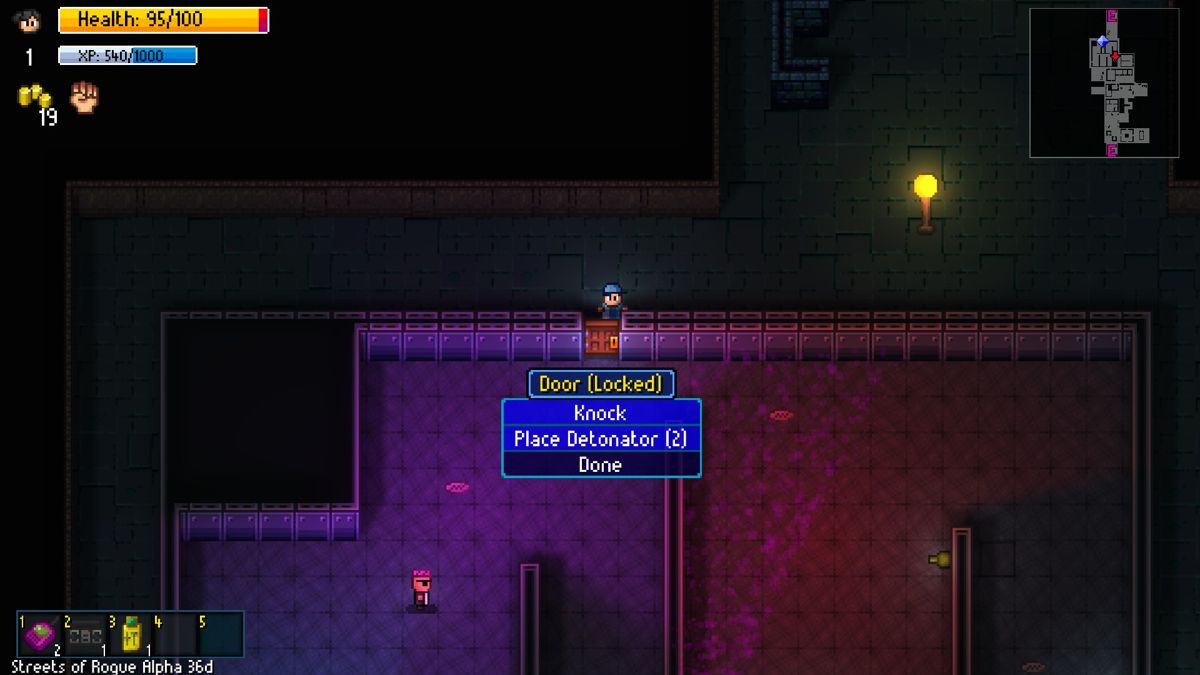 This menu might sometimes
look like a dialogue minigame.
But it’s always simply a menu for choosing an action.
This may seem trivial but think about all the times you couldn’t cast spells in the middle of dialogue because the writer didn’t add an option to do it4. Or when you snuck up on an enemy, only to be whisked away to a scripted fight where they attack first.
In Streets of Rogue, this comes down to organically choosing how to approach each objective and adapting that plan on the fly. Usually by starting with stealth or diplomacy and ending with a fight and/or running away.
Lowest common denominator
This leads us to the weakest part of Streets of Rogue. To be fair, I am not sure if there is a solution to this problem.
See, the player has to be able to accomplish each mission regardless of their current state. There should never be a situation where the player has effectively lost but the game is not over yet.
Therefore, three things are always available to the player. The player can always 1) walk to an objective, 2) interact with it and 3) neutralize it if it is the goal of the mission.
In practice this means that even a character with the pacifist trait like the doctor, can still punch people. It also means that bypassing the entertaining systems and punching your way through is always a viable path.
This is smart from a UX perspective but does mean that nothing prevents players from gravitating towards the easiest available strategy instead of engaging with the variety of systems on offer.
Explicit objectives
But on the more positive side are those objectives themselves. There’s a decent amount of variety of objectives and approaches. But what I want to focus here is the clarity of the mission information.
On each level, you have to complete several missions to be allowed to leave the level. The location and nature of these is immediately available in your map screen, and you usually check these as soon as you enter a level5.
Now quest markers have a bad reputation for a good reason. And this wouldn’t work for every game, especially any game where exploring the environment is the point.
But here I think it works for two reasons.
First, there is no environmental storytelling to absorb. The levels are procedurally generated and meant to be progressed through at a brisk pace. There is also no pretense of the player investigating a mystery or searching for secrets. The narrative is that each mission is a briefing from the HQ.
Second, the levels are 2D and fairly small. This means that often it’s enough to look at the map to get a general idea of the direction the objective’s in. The challenge is not in finding the objective and completing the objective is never as straightforward as walking up to it and pressing E.
Often you are making a plan based on the objective’s location, surrounding patrols, your abilities and other threats and opportunities. Which is also something that is uncommon in RPGs, at least outside of combat encounters.
Conclusion
There’s a lot more to say about Streets of Rogue that I didn’t cover here. If you would like to know more, play the game yourself or check out this video from Lychee Game Labs.
That’s it for the first installment of RPG studies. Hope you have a great day and I will see you next time.
P.S. I am still figuring out Jekyll. You can see I found out how to make footnotes and embed images and videos. I still wanna overhaul the site at some point though.
-
I know some people still call these “roguelites” but I think that ship has sailed years and years ago. I know, I know. I used to harp on about this as well. ↩
-
The other cops won’t stop you and sometimes the cost is worth it. Just like a real police officer. ↩
-
To be fair, this is almost always an architectural issue, not the fault of the writer. Traditional dialogue trees are really resistant to player verbs. ↩
-
There is an interesting parallel with the Trophy RPG tabletop roleplaying system, where players are also explicitly told what their objective is in each scene. I would like to see this in practice one day. ↩